


Written by Mark Langshaw Reviewed by Jessica Peck
Sources
23 April 2026
First Published
Adopting renewable energy for your business is a great way to reduce its carbon emissions, save money on your bills and boost your sustainability credentials.
Here you will learn what kind of sustainable energy solutions are available for businesses, the advantages of adopting, and where to get expert advice on this.
What renewable energy solutions are available for businesses?
As the UK pushes towards its Net Zero targets, many businesses are looking beyond standard fixed-rate energy contracts to see how they can future-proof their operations with renewable energy. Generally, there are two ways to go green: you can either "buy" it through a specific energy-efficient tariff or "make" it by installing your own infrastructure.
1. Green energy tariffs
The simplest way to switch to greener energy is by choosing a renewable plan. These are often backed by REGO (Renewable Energy Guarantees of Origin) certificates.
This scheme ensures that for every megawatt-hour (MWh) of electricity your business consumes, the supplier has sourced the same amount from a renewable source, such as a wind farm or solar park.
It’s a good idea to speak to an independent energy adviser before you move forward with any plans to switch to a green energy deal. The right adviser can help you access every green deal on the market and can compare them all to help you find the right tariff.
2. On-site generation
For firms with the capital to invest, installing your own renewable tech can lower long-term overheads and provide protection against market volatility. Popular solutions include:
-
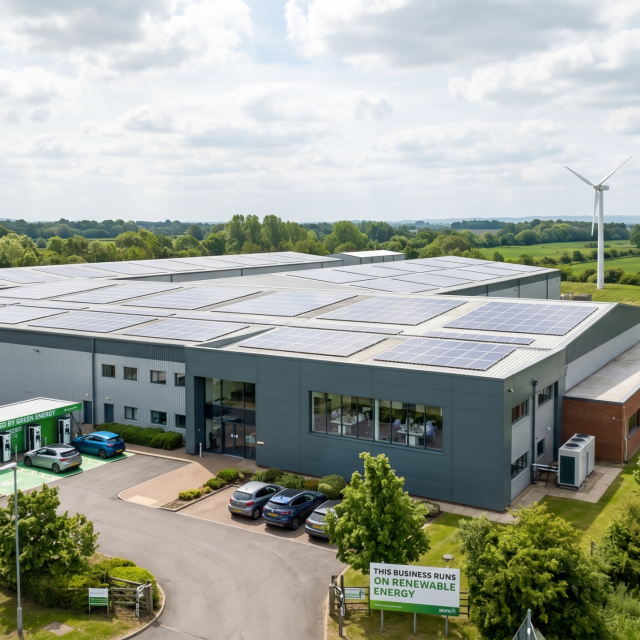
Solar PV Panels: These convert sunlight into electricity. They are the most common choice for UK SMEs because they can be easily installed on warehouse or office roofs. With the Smart Export Guarantee (SEG), you can even sell excess power back to the grid.
-
Heat Pumps (Air or Ground Source): These work like a refrigerator in reverse, extracting heat from the air or ground to warm your premises. They are far more efficient than traditional gas boilers and can drastically reduce your "Scope 1" direct emissions.
-
Wind Turbines: While less common in urban areas, small-scale turbines are a highly effective solution for rural businesses or those with large amounts of land.
-
Biomass Systems: These involve burning organic materials (like wood pellets) to produce heat. This is often a viable alternative for industrial businesses that require a constant, high-temperature heat source.
Benefits of adopting renewable energy
Moving to renewable business energy isn't just about corporate social responsibility (CSR); it’s a strategic financial move that could help your business save money in the long run.
-
Tax Incentives: Businesses can often claim capital allowances on the installation of energy-saving technology, allowing you to deduct the cost from your taxable profits.
-
Energy Independence: Generating your own power shields your business from the "price spikes" seen in the global gas market, making your annual budgeting far more predictable.
-
Better Finance Rates: Many banks now offer "Green Finance" options, providing lower interest rates for loans used specifically to fund sustainable business upgrades.
If you aren’t sure which solution fits your premises, we recommend a business energy audit. An expert adviser can assess your current usage and pinpoint whether a simple tariff switch or a full solar installation would provide the best return on investment for your firm.
Renewable energy grants for UK businesses
The initial cost of installing renewable technology can be a significant barrier for many UK firms. There are, however, several government-backed schemes and regional grants designed to ease the financial burden and accelerate the transition to low-carbon operations.
Unlike standard business loans, these grants typically don’t need to be repaid, though they often require "match funding" - meaning the business covers a portion of the project costs.
1. The Boiler Upgrade Scheme (BUS)
While widely known for domestic use, the Boiler Upgrade Scheme is also open to small business premises. This provides a fixed grant of £7,500 to help cover the cost of replacing fossil fuel heating systems with air source or ground source heat pumps. It’s a straightforward way for SMEs to modernise their heating infrastructure with a significant upfront discount.
2. Regional Low Carbon Grants
Much of the funding for business renewables is distributed at a local level through Local Enterprise Partnerships (LEPs) or local councils. These are often targeted at SMEs and can cover:
-
Energy Efficiency Audits: Fully funded professional reviews of your energy use.
-
Capital Grants: Funding for solar panels, LED lighting, or insulation. These typically range from £1,000 to £25,000, depending on your location and the projected carbon savings.
Note: As these schemes are regional (such as the 'Clean Growth' funds in the North or 'Green Business' grants in the Midlands), you should check with your local authority to see what is currently active in your postcode.
3. Industrial Energy Transformation Fund (IETF)
For larger businesses or those in energy-intensive industries (like manufacturing or data centers), the IETF provides substantial funding. This grant is specifically designed for high-energy users to invest in deep decarbonisation and energy efficiency projects that would otherwise be too expensive to justify.
4. Tax Incentives: The "Super-Deduction" Successor
While not a direct grant, the Full Expensing tax break is one of the most powerful financial tools for UK businesses. It allows companies to deduct 100% of the cost of qualifying plant and machinery - including many renewable energy installations - from their taxable profits in the year of purchase. For every £1 million a business invests in green tech, they could potentially cut their tax bill by up to £250,000.
5. Smart Export Guarantee (SEG)
While technically a subsidy rather than a grant, the SEG is a vital part of the financial puzzle. It requires energy suppliers to pay you for every unit of renewable electricity you generate but don't use. By "selling back" your excess solar or wind power to the grid, you create a secondary revenue stream that helps pay off the initial installation cost faster.
How to switch to renewable energy sources
The process should begin with a free, no-obligation energy health check for your business, conducted by an independent energy adviser. During the process, they will carry out analysis into your carbon footprint and energy costs to explore where improvements can be made.
Your adviser will grant you access to a dashboard with all of the data you need on it and interpret this information to offer guidance on whether switching to a greener energy tariff or exploring sustainable on-site energy generation is in your best interest.
After conducting an analysis of your energy consumption and carbon output, your adviser will offer guidance on the following:
-
Switching to a green energy tariff, if it’s in your best interest
-
Sourcing the best sustainable energy solution for your business
-
Whether adopting electric vehicles is in your firm’s best interest
-
Whether you qualify for any sustainable energy grants or schemes
Get started below to book your free, no-obligation energy health check and find out how much you could save by switching to renewable energy sources.

Book a renewable energy consultation
Types of businesses that can benefit from renewable energy
In short, all business types can potentially benefit from switching to renewable energy, but exactly what type of sustainable power is right for your firm will depend on a host of factors, including the sector it operates in, the size of the company and more.
This is why it’s a good idea to seek independent advice before you explore renewable energy solutions. The right adviser can help you draw up a tailored plan based on your firm’s needs, circumstances and typical energy consumption.
Types of businesses we have helped with this in the past include:
-
SMEs and micro businesses
-
Farms and agriculture businesses
-
Small hotels
-
Small gyms
-
Small restaurants
-
Contractor businesses
-
And more
Best renewable energy suppliers for UK businesses
Choosing a green supplier isn’t just about the environmental impact; it’s about finding a partner that offers the right technology, such as smart export tariffs and carbon reporting. While almost all major suppliers now offer "100% renewable" electricity, the following providers are currently leading the market for business-specific green solutions.
1. Octopus Energy: Best for Smart Technology
Octopus has quickly become the gold standard for businesses looking to integrate technology with their energy supply. They are particularly well-suited for SMEs that have already invested in green tech like EVs or solar panels.
-
The Standout Feature: Their "Agile Business" and "Shape Shifter" tariffs allow firms to pay lower rates when wholesale prices are low or when renewable generation is high.
-
Best For: Tech-savvy businesses and those with high electricity usage during off-peak hours.
2. SmartestEnergy: Best for Comprehensive Sustainability
SmartestEnergy focuses specifically on the business sector and is a popular choice for firms that need to prove their green credentials to stakeholders or through ESG (Environmental, Social, and Governance) reporting.
-
The Standout Feature: They provide 100% renewable electricity that is fully traceable to specific UK wind, solar, or hydro generators. They also offer "Natural Gas" options that are carbon-neutral through offsetting.
-
Best For: Medium-to-large enterprises that require detailed carbon footprint reporting.
3. Good Energy: Best for Ethical Sourcing
Unlike some suppliers that simply buy renewable "certificates," Good Energy is a B Corp that buys power directly from a community of over 1,700 independent UK generators.
-
The Standout Feature: Their "Real-Time Matching" ensures that the energy you use is actually being generated by a renewable source at that exact moment, rather than just being "offset" annually.
-
Best For: Businesses where ethical sourcing and supporting the UK's local renewable infrastructure is a core brand value.
4. Ecotricity: Best for Green Gas Alternatives
Ecotricity was the world's first green energy company and remains a pioneer, particularly in the development of "Green Gas" (biomethane) produced from grass.
-
The Standout Feature: They use their profits to build new wind and solar parks, meaning your business energy bills directly fund the construction of new UK green infrastructure.
-
Best For: Firms looking for a "frack-free" gas supply and those who want to see their bills reinvested into the UK’s energy transition.
5. SSE Energy Solutions: Best for Large Infrastructure
As one of the UK's largest generators of renewable energy, SSE is a "Big Six" provider that offers the stability and scale required by large industrial users.
-
The Standout Feature: They offer "Green Fixed" contracts that provide long-term price certainty alongside 100% renewable electricity. They are also leaders in providing large-scale EV charging infrastructure for commercial fleets.
-
Best For: Large-scale commercial operations and industrial sites that need high-volume, reliable green power.
Summary: Which should you choose?
The table below offers a quick breakdown of what each of the UK’s leading renewable energy suppliers offers and what they specialise in.
|
Supplier |
Best For... |
Key Advantage |
|
Octopus Energy |
Tech & EVs |
Cutting-edge smart tariffs |
|
SmartestEnergy |
ESG Reporting |
Fully traceable UK generation |
|
Good Energy |
Ethical Ethics |
B Corp status & 1:1 matching |
|
Ecotricity |
Green Gas |
Profits fund new green builds |
|
SSE Solutions |
Industrial Use |
Large-scale stability & fleet charging |
Book your renewable energy consultation today
If you are interested in exploring renewable energy solutions for your business but don’t know where to begin, we can help. The advisers we work with offer free, no-obligation sustainable energy consultations that can help you draw up the right strategy.
Get started here to book your free energy health check below and find out how much you could save, and how much you could lower your carbon output by, today.
FAQs
The main drawback is often the upfront cost of infrastructure; while green energy saves money long-term, installing solar panels or heat pumps requires significant initial capital.
Additionally, some businesses may find on-site generation variable - for instance, solar output drops on cloudy days or at night - which is why most firms remain connected to the grid or invest in battery storage. Finally, the regional nature of grants means that the level of financial support available can vary significantly depending on your business's postcode.
Avoiding fossil fuels is a strategic move to protect your business from global market volatility and "price spikes" that frequently affect gas and oil. Beyond the financial risk, fossil fuels contribute heavily to a firm’s carbon footprint, which can damage your brand reputation and sustainability credentials. As the UK moves toward Net Zero targets, businesses reliant on fossil fuels may also face future regulatory hurdles or miss out on "Green Finance" options that offer lower interest rates for sustainable firms.
No. If you are simply switching to a green energy tariff, no new hardware or wiring is required. Your electricity will still be delivered through the same National Grid infrastructure, but your supplier ensures that the equivalent amount of energy you use is generated from renewable sources like wind or solar.
You should look for tariffs backed by REGO (Renewable Energy Guarantees of Origin) certificates. These certificates provide a paper trail proving that every MWh of electricity you consume is matched by renewable generation. For the highest transparency, look for suppliers like Good Energy or SmartestEnergy, which offer 1:1 real-time matching or fully traceable UK generation.
Yes. Through the Smart Export Guarantee (SEG), businesses that generate their own power via solar panels or wind turbines can sell any unused electricity back to the grid. This creates a secondary revenue stream that can help offset your initial installation costs more quickly.