


Written by George Sweeney Reviewed by Tom Johnson
10 June 2026
First Published
Using your Self-Invested Personal Pension (SIPP) to support borrowing or lending arrangements can be an attractive financial planning strategy in certain situations. Here, we explain what a SIPP loan is, how SIPP borrowing and lending work, the HMRC rules, and where to find independent professional pension advice.
What is a SIPP loan?
This typically refers to either borrowing using a SIPP to buy commercial property or using SIPP funds to set up a lending arrangement with an unconnected third party (or using loan-based investments such as loan notes).
SIPP loan rules
HMRC imposes strict rules around SIPP lending and borrowing to prevent pension funds from being accessed improperly or used incorrectly.
Some of the main SIPP loan rules include:
-
Connected parties: Direct loans to connected parties (e.g. yourself, your family, your own company, or sponsoring employers) are generally not permitted.
-
Commercial terms: Any lending must be on commercial terms and comply with both HMRC legislation and the pension provider’s own rules.
-
Penalties: Transactions involving connected parties, taxable property, or non-commercial arrangements can trigger significant tax charges (40% of the loan’s value under current rules).
-
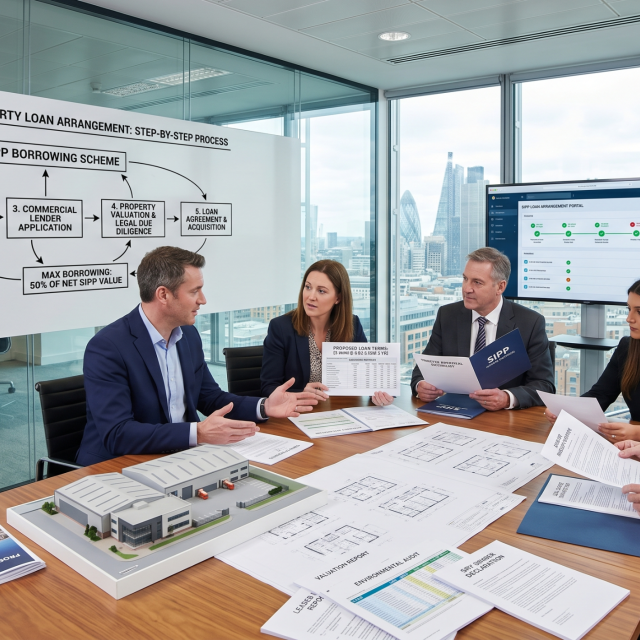
Borrowing limits and purpose: A SIPP can normally borrow up to 50% of its net asset value (NAV). Borrowing is largely for commercial property purchases.
While most mainstream SIPP providers prohibit direct lending altogether, some specialist SIPP providers may permit certain structured loan arrangements involving unconnected third parties.
Because provider rules are often stricter than HMRC legislation, the types of borrowing and loan-based investments available can vary significantly between providers.
How SIPP lending works
While most mainstream SIPPs don’t allow direct loans, some specialist SIPPs may permit loans to third parties (people and companies unconnected to you) under certain conditions.
These arrangements are usually structured as investment transactions rather than informal loans and are typically available only through specialist or bespoke SIPP providers.
Third-party and unconnected party loans
Some specialist SIPPs may permit third-party loans, secured lending arrangements, or loan notes, provided:
-
The loan arrangement is commercially structured
-
The borrower is an unconnected third party
-
The investment satisfies the provider’s rules
-
The loan usually must be secured via a first-charge on an asset
-
The investment complies with current pension legislation
In most cases, these arrangements are structured through secured loan agreements or specialist investment vehicles rather than informal private loans. Many pension providers take a cautious approach because these loan arrangements can involve:
-
Liquidity risks
-
Valuation complexity
-
Regulatory scrutiny
-
Potential unauthorised payment tax charges
-
Scam and fraud concerns
Loan notes inside a SIPP
Some investors use loan notes (similar to bonds) within a SIPP pension as an alternative investment strategy.
A loan note is essentially a form of debt investment in which your pension funds are invested in a debt instrument issued by a company in exchange for interest payments. So essentially, your SIPP is providing a loan to that company.
However, loan notes inside pensions can carry substantial risks, which is why many mainstream SIPP providers restrict or prohibit these investments altogether.
SIPP loans to employers
Unlike a SSAS (Small Self-Administered Scheme), SIPPs cannot normally be used to make direct “loan-back” arrangements to a sponsoring employer. This is one of the main differences between a SIPP and a SSAS.
If your goal is to use your pension assets to support borrowing for your business, a SSAS is often the more commonly used structure because it allows regulated loan-back arrangements under specific HMRC conditions.
How SIPP borrowing works
Borrowing within a SIPP is far more common than SIPP lending. Most SIPP borrowing is used for commercial property purchases or refinancing.
Under the current SIPP rules, borrowing is generally capped at 50% of the SIPP’s NAV. Any property purchased is owned by the SIPP itself, and any rental income is paid back into the pension.
SIPP mortgage borrowing is often used by business owners who want their pension to purchase their own commercial premises. The business then pays commercial rent back into the pension, which can be a tax-efficient way to build retirement wealth.
Do you need professional advice?
Because SIPP loan rules are highly nuanced, getting professional advice is often extremely worthwhile before you enter into any borrowing or lending arrangement involving your pension.
An independent SIPP pension adviser can help you:
-
Understand whether a SIPP or SSAS is more appropriate
-
Review pension provider restrictions and lending rules
-
Assess various commercial property borrowing structures
-
Evaluate risks around loan notes or third-party loans
-
Ensure complete compliance with current HMRC pension rules
Expert advice is particularly important if you’re considering deploying more advanced investment or loan strategies with your SIPP.
If you’d like help reviewing your pension borrowing or lending options, you can speak with an independent FCA-regulated pension adviser here.

Get 100% independent pension advice
SSAS loans
A SSAS (Small Self-Administered Scheme) can be more flexible than a SIPP in certain situations because SSAS pensions allow loan-back arrangements to employers under certain conditions.
Under existing SSAS loan-back rules:
-
Loans can typically be made to the sponsoring employer.
-
The loan term is restricted to 5 years.
-
There must be equal repayments of capital and interest in each year.
-
Loans are usually capped at 50% of the SSAS's net value.
-
It usually needs to be a secured loan against an asset.
-
Interest must be charged at commercial rates, typically 1% above the average base lending rates of 6 leading UK banks.
Because of these features, SSAS pensions are often more suitable than SIPPs for business owners looking to access pension-based lending strategies.
UK pension provider approaches to SIPP loans
Here’s a general overview of how some pension providers typically approach SIPP loans and borrowing:
|
Provider |
Approach to SIPP loans |
|
Denton Pensions |
Will consider SIPP loans up to 95% of the net market value of the SIPP, provided it’s secured by a first charge on a UK property with a maximum LTV of 70%. A minimum SIPP fund size of £60,000 is required, and a bank account balance of at least £5,000 must be maintained. |
|
Ability to loan up to 70% of the net value of the pension’s assets, and loans can only be made to an unconnected third-party limited company that has been active for 12 months with available trading accounts. |
|
|
Curtis Banks |
Only allows loans to a sponsoring employer company with a SSAS, and doesn’t allow loans to connected or unconnected parties with a SIPP. |
|
Barclays |
Doesn’t allow SIPP loans, but you can borrow for commercial property using a SIPP or SSAS pension, and it offers a specific “green property loan” to purchase or refinance an energy-efficient commercial property. |
|
Mainstream SIPPs |
Providers such as AJ Bell, Hargreaves Lansdown (HL), interactive investor (ii), and Fidelity typically do not permit bespoke direct lending arrangements or specialist unconnected third-party SIPP loans. |
Different providers take varying approaches to SIPP borrowing and lending-related investments, so it’s always worth taking the time to review your options with an expert. Most specialist providers don’t advertise all the options available because they take a tailored approach with clients.
Get 100% independent pension advice today
SIPP loans, borrowing structures, and pension lending arrangements can be highly complex and involve significant tax and regulatory considerations.
Here’s why people trust Money Helpdesk for independent pension advice:
-
Access to independent, FCA-regulated pension advisers
-
Help reviewing SIPP loans and lending structures
-
Support comparing SIPP and SSAS arrangements
-
Free initial consultation with no obligation to proceed further
If you’d like to explore whether a SIPP loan or pension borrowing strategy may be suitable for your goals, you can arrange a free, no-obligation chat with an expert adviser here.
FAQs
Potentially, yes. Some SIPPs may allow loans to unconnected third parties. However, many providers restrict these arrangements, and professional advice is strongly recommended.
Third-party loans within a SIPP usually refer to pension investments involving loans to unrelated businesses or projects, often through secured loan agreements, loan notes, or specialist investment structures.
In most cases, no. Standard SIPPs cannot usually make direct loans to connected employers or businesses. This type of arrangement is more commonly associated with SSAS pensions.
Yes. Under current HMRC rules, a SIPP can normally borrow up to 50% of its net asset value, usually for commercial property purchases.
A SIPP commercial property loan is a mortgage or borrowing arrangement used by a SIPP to help purchase commercial property held within the pension.
Sometimes. Certain providers may permit loan notes inside a SIPP, but these investments are often restricted due to liquidity, valuation, and regulatory risks.
The biggest difference is that a SSAS can potentially lend money back to a sponsoring employer under HMRC rules, whereas SIPPs generally cannot make connected-party loans.